
Local
Bengaluru's hard water, and what it does to your appliances
Water hardness in Bengaluru runs from about 160 ppm in the older central wards to 560 ppm in parts of the outer east. The harder the water, the faster scale builds on anything that heats it, so a geyser element or a washing machine heater wears out sooner and needs descaling more often.
By Kaif Sharieff, Fixit BLR · published · reviewed

Why hardness changes so much across the city
Bengaluru is not on one water supply. Much of the central city gets treated Cauvery water from the Bangalore Water Supply and Sewerage Board, at 160 to 240 ppm hardness. Many outer areas rely on borewells and tankers, and in parts of the outer east that water measures 480 to 560 ppm. Even neighbouring areas can differ: Kammanahalli, on Cauvery mains, reads softer than HRBR Layout next door.
Scale is the layer of minerals hard water leaves on anything that heats it. It insulates the element: with 2 mm of scale on the sheath, an element has to run hotter and longer to heat the same water. So the failure creeps up. First a cycle takes 15 to 20 minutes longer, then the water comes out lukewarm, then the element stops working.
Hardness by area
| Area | Typical hardness | What it means |
|---|---|---|
| Whitefield, Varthur, Kadugodi, Panathur | 480 to 560 ppm | Descale every 6 months; coated element; anode rod every 2 to 3 years |
| Sarjapur Road, Kasavanahalli, Haralur | 460 to 540 ppm | Descale every 6 months; expect early element failure if it is skipped |
| Electronic City | 410 to 470 ppm | Descale every 6 months; shared PG geysers wear several times faster |
| Marathahalli, KR Puram, Hoodi, Brookefield, Mahadevapura | 380 to 440 ppm | Descale every 6 months; the inlet strainer silts with grit |
| Yelahanka, Hennur, north Bengaluru | 360 to 430 ppm | Descale every 6 months; detergent dissolves poorly and smells follow |
| Bellandur, HSR, Hebbal, BTM Layout, JP Nagar, Banaswadi, Kalyan Nagar | 290 to 380 ppm | Moderate. Descale every 12 to 18 months |
| Indiranagar, Koramangala, Rajajinagar, Banashankari, Domlur, Ulsoor, HAL, CV Raman Nagar, Kammanahalli, Cooke Town, Frazer Town | 180 to 240 ppm | Cauvery supply. Scale is rarely the main fault |
| Jayanagar, Basavanagudi, Malleshwaram | 160 to 220 ppm | The softest band in the table; a smell usually comes from leftover detergent |
These are typical ranges for each area's usual supply, Cauvery or borewell, and your own building can read higher or lower. Several areas, including Marathahalli, BTM Layout, JP Nagar, Banashankari, Rajajinagar and the newer areas added to each row, are estimated from their neighbours on the same supply. Apartment supply is often blended, so a Sarjapur Road tower fed partly by Cauvery and partly by borewell can sit 100 ppm below its neighbours. Your association or borewell operator will have the latest test.
How to tell if your water is hard
- Look at the taps. A white crust on tap aerators, shower heads and the inside of a kettle is scale.
- Ask for the test. Many apartment associations and borewell operators keep a recent water test.
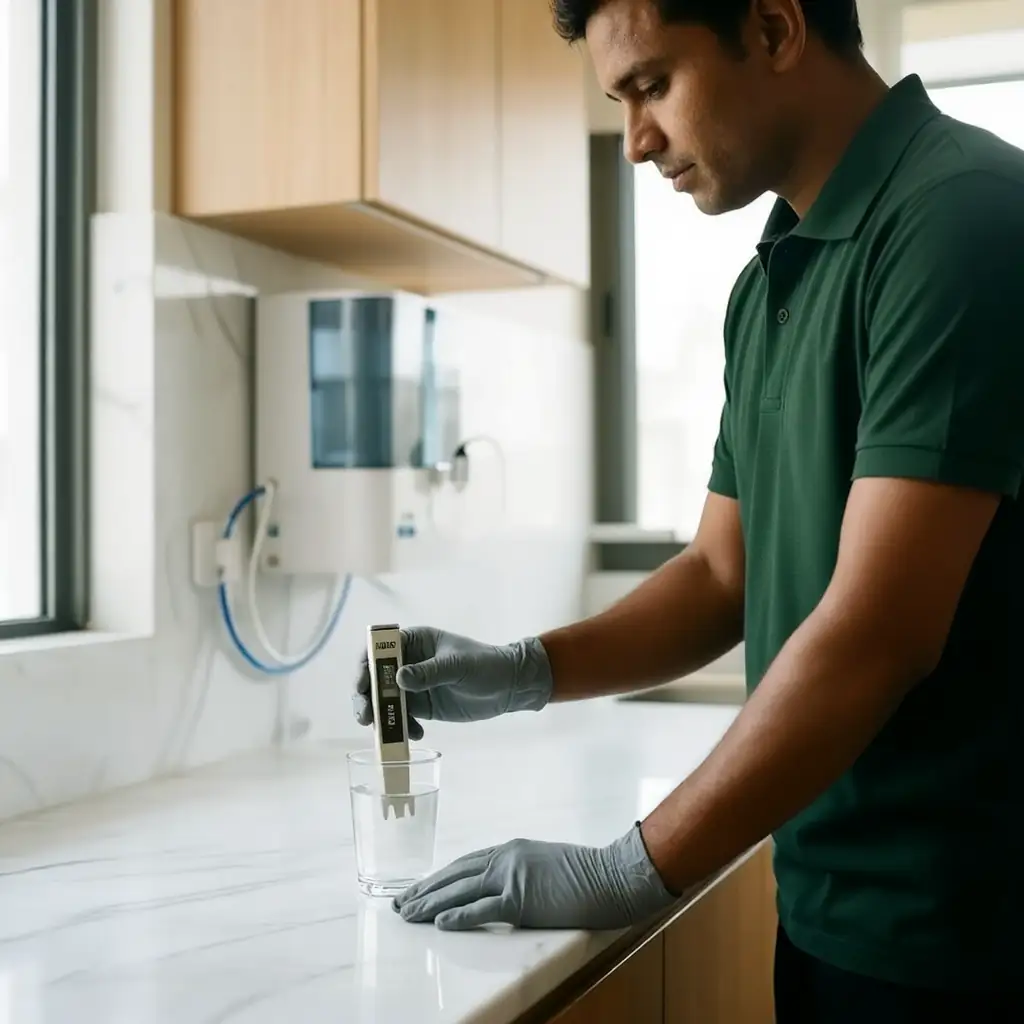
- Use a TDS meter. It reads in seconds at the tap. TDS is a different measure from hardness, but it is the number that decides whether you need an RO purifier.
What hard water does to each appliance
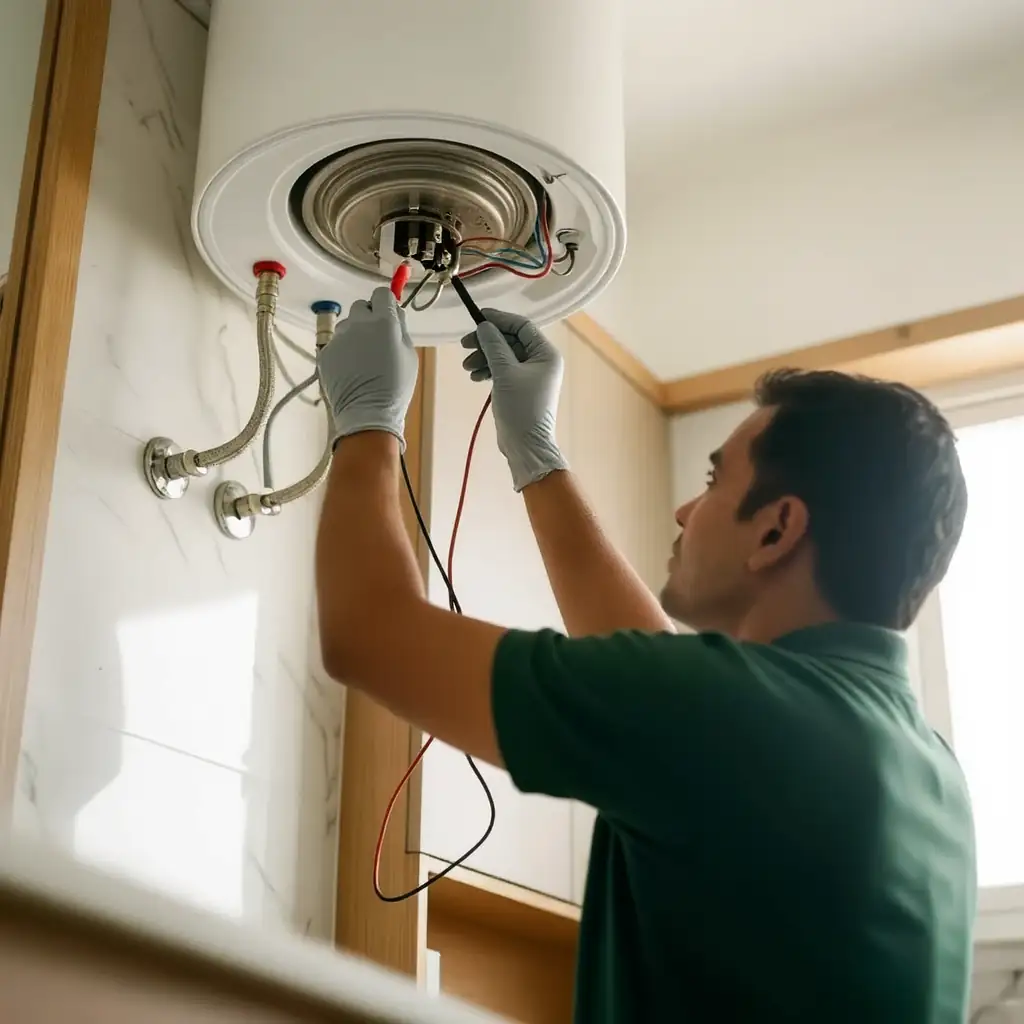
- Geysers. The element scales and the tank collects sediment. Once the anode rod has dissolved it stops protecting the lining, and when the inner tank corrodes the geyser cannot be repaired. A 2 kW element is ₹1,299 to ₹3,199 fitted. See geyser repair.
- Washing machines. The heater scales, and detergent does not dissolve properly, which is the usual reason a machine starts to smell. See washing machine repair.
- Water purifiers. On borewell water an RO membrane scales and the sediment filter chokes sooner, so the tank fills slowly and the water can taste flat or salty. A full filter set is ₹1,199 to ₹2,499 fitted and a membrane ₹1,799 to ₹4,199. See water purifier repair.
- Chimneys and ACs. Neither takes water from the supply, so hard water does not affect them. The water an AC drips is condensed out of the room air. If a quote for either includes a descaling charge, decline that line.
How to descale a washing machine yourself
- Empty the drum.
- Add a washing machine descaler sachet as the pack directs.
- Run the hottest empty cycle the machine has.
- When it finishes, wipe the rubber door seal dry and leave the door open to air the drum.
A geyser is a different job. The tank has to be drained and flushed and the element descaled, and the anode rod and safety valve are checked at the same visit, so it needs a technician. A geyser descale falls in the ₹639 to ₹1,599 common band.
What slows the damage
- Match the purifier to the water. Read the TDS before you buy one. Under 500 mg/L, which covers most Cauvery supply, a UV or UF purifier is enough and wastes no water. Above it, an RO is worth having.
- Descale every 6 months above roughly 400 ppm. Every two years or so suits the Cauvery-fed central areas.
- Replace the geyser's anode rod every 2 to 3 years on hard water. It is cheap, and it has to be done before the tank corrodes, because after that it is too late.
- Fit a coated element when the old one fails. It costs more than the cheapest bare element, and in a borewell area it outlasts two bare ones.
Whole-house softeners also help, but choosing one is a plumbing decision, and we do not fit or sell them.
Find your area
If you are not sure which supply your building is on, the areas page has a pincode lookup. The difference between Malleshwaram at 160 ppm and Whitefield at 560 is large enough to change how often you should descale.
Questions
How do I find out how hard my water is?
Ask your association or borewell operator for the last water test; many keep one. If there is none, the table above is a fair guide: Whitefield runs 480 to 560 ppm and Sarjapur Road 460 to 540, while the Cauvery-fed central wards are 160 to 240. A TDS meter at the tap answers the purifier question in seconds, though TDS and hardness are different measures.
How often should a geyser be descaled in Bengaluru?
Every 6 months from roughly 360 ppm up, which covers Whitefield, Sarjapur Road, Electronic City, Marathahalli, KR Puram and Yelahanka. Every 12 to 18 months is enough in the middle bands, and two years or more in the softest Cauvery-fed wards. Have the anode rod checked at the same visit and replaced every 2 to 3 years on hard water. A scaled 2 kW element is ₹1,299 to ₹3,199 fitted, while a corroded inner tank cannot be repaired at all.
Do I need an RO water purifier in Bengaluru?
It depends on the water your building gets. BWSSB's Cauvery supply is reported below about 200 ppm TDS, inside the 500 mg/L that the IS 10500 standard accepts, so a UV or UF purifier is usually enough. Borewell and tanker water often reads far higher, and there an RO is worth having, with its filters changed more often. An RO sends two to three litres to the drain for every litre it gives you.
Does hard water damage a chimney or an AC?
No. Neither takes water from the supply, so there is nothing for scale to form on. Chimney trouble is grease in the filters and the blower, and AC trouble is dust in the filters and coils or a slow gas leak. If a quote for either includes descaling, you can turn that line down.

Pages that go with this
We repair all major appliance brands
We repair every make out of warranty, across Bengaluru. Tap yours to book.


Still not working? Book now, pay after the job.
Tell us what it is doing and we will tell you what it usually is, and what it usually costs, before anyone comes out.